04.08.12
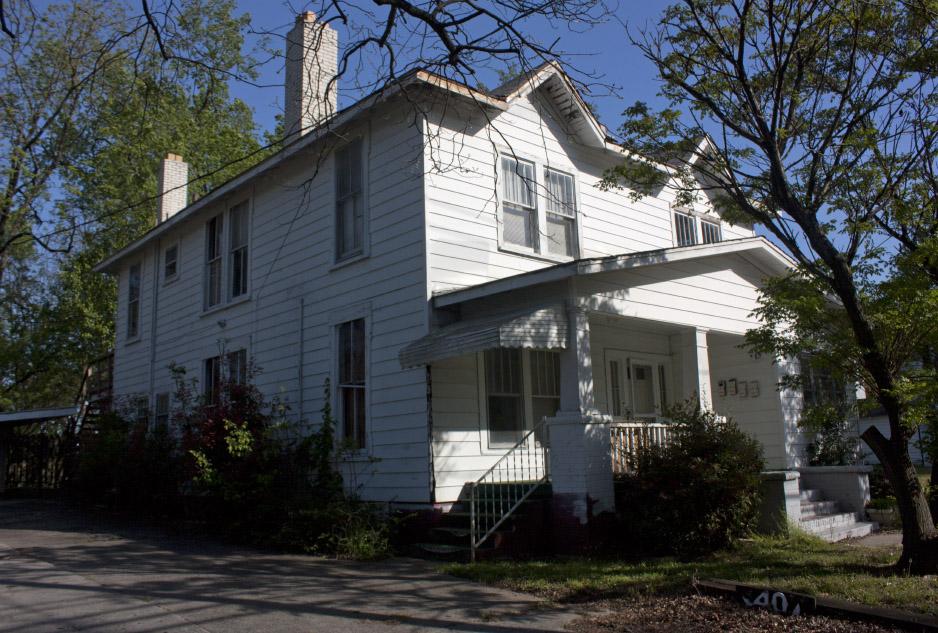
Daisy E. Scarborough purchased the lot that would eventually become 1407 Fayetteville Street in 1920. This lot was intended to be built on if and when Daisy’s daughter, Ernestine S. Bynum, wanted to settle down in Durham and build her own home. The home was built circa 1937, after Ernestine’s father built the property as a means for Ernestine to receive additional income. For the time being, the property was a rental home, largely occupied by local laborers.
Ernestine Scarborough Bynum was born in 1911 in Durham, North Carolina. She was the daughter of John C. Scarborough, the first licensed Black embalmer in North Carolina, and Daisy E. Scarborough. John ran a prominent funeral home in Durham, the Scarborough and Hargett Funeral Home. Daisy passed away when Ernestine was young. After Daisy’s passing, Ernestine spent much of her youth attending boarding schools, returning to Durham for the summer to work at the funeral home.
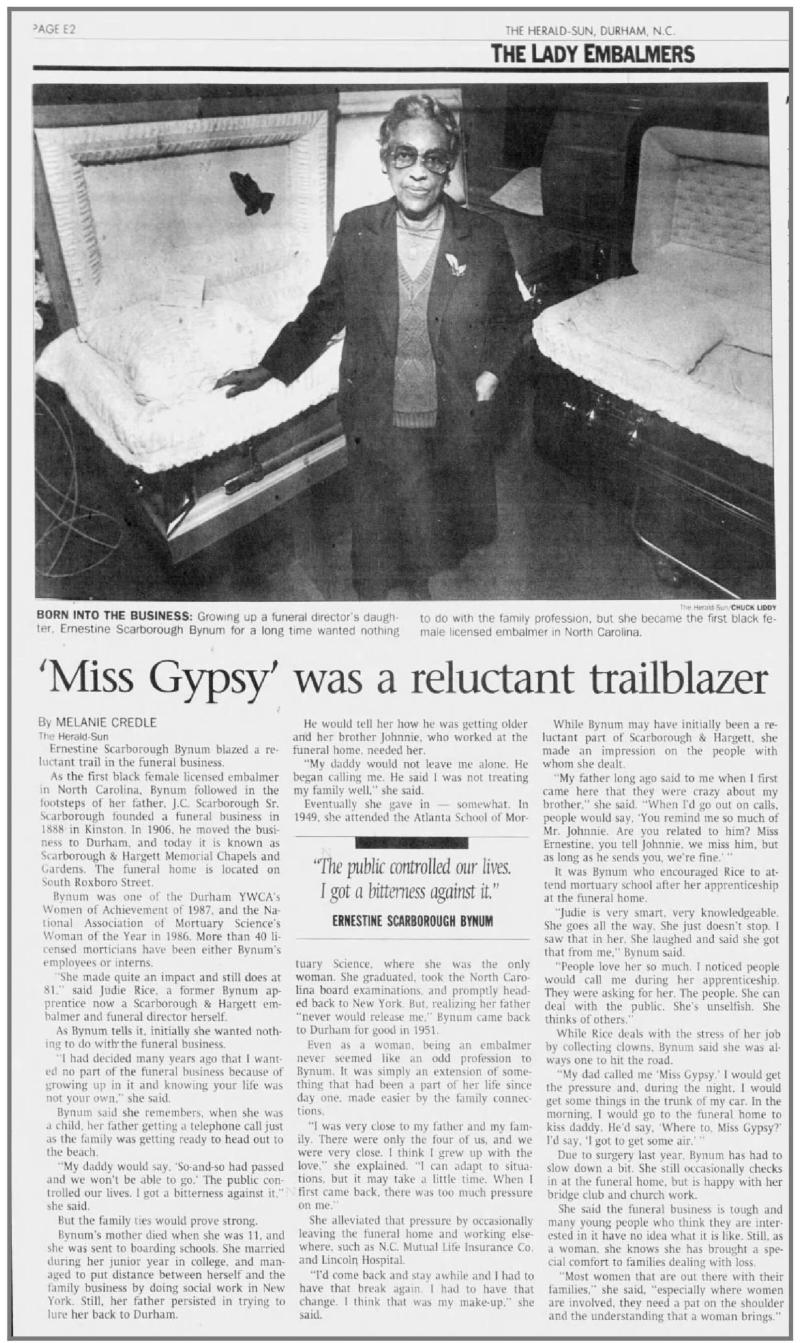
Ernestine had originally attempted to distance herself from the funeral business, feeling as if the “public controlled our lives” throughout her youth. She attended St. Augustine’s College in Raleigh, North Carolina, and was married to Theodore Johnson in 1934. The couple moved to New York, where Theodore worked as a social worker. He inspired Ernestine to also go into social work. Theodore went on to get an embalming license, and after becoming close with Ernestine’s father and brother, the couple moved to Winston-Salem, North Carolina, to help run a Scarborough and Hargett Funeral Home there. While in Winston-Salem, Ernestine worked in the school system. After two years, she could no longer handle the proximity to the funeral business and moved away from Theodore, back to New York City. She eventually remarried in 1946 to Wilfred L. Bynum, but they divorced in 1952, and she never remarried afterwards. During her time away, her father continued to hold hope that she would eventually return to Durham to help run the family business, having the home built at 1407 Fayetteville Street, and routinely calling to ask her to help her brother Johnny with the funeral business.
Ernestine relocated to Cincinnati, Ohio, and then Atlanta, Georgia, where she took courses to get her mortuary degree, which she earned in 1951. She became the first African-American woman to receive her embalming license in North Carolina, following in her father’s footsteps. She returned to Durham in 1951, first living in her childhood home at 1406 Fayetteville Street, then moving into the home at 1407 Fayetteville Street circa 1954. After relocating to Durham, she did intermittent work at the funeral home, needing breaks from the business every so often. She worked at numerous other prominent African-American-run institutions during her breaks, including North Carolina Mutual Life Insurance Company, Merrick-Moore School, and Lincoln Hospital.
She eventually settled in working at Scarborough and Hargett Funeral Home and would become the manager of the firm. While Ernestine admitted that the funeral business could be challenging and time-consuming, she ultimately did not regret moving back to Durham and working for her family’s business, as she believed she was doing right by her family. Her father expressed that a woman needed to be involved with the funeral business, as he believed women were more attuned to helping with “those little touchy points where men just can’t be that soft or don’t want to be that soft.” Ernestine carried this belief into her work with the funeral home.
In 1968, she earned an honorary doctorate in Mortuary Administration from Bethol Institute for Mortuary Managers and Personnel. This was just one of many awards Ernestine was honored with throughout her life. Some of her other notable awards include the 1987 YWCA Women of Achievement medallion and the National Association of Mortuary Science’s 1986 Woman of the Year. She was also the first female president of the Funeral Directors and Morticians Association of North Carolina, Inc.
After moving back to Durham, Ernestine planted herself in the Durham community in multiple ways. Growing up, she attended St. Joseph’s A.M.E Church with her parents, both devout Christians. She continued to attend St. Joseph’s A.M.E. after returning to Durham. She was also a member of the Rho Chapter, Iota Phi Lambda Sorority, the Durham chapter of the business sorority.
After moving into 1407 Fayetteville Street, the home across from her childhood home, in the mid-1950s, Ernestine lived there the rest of her life, often living with renters. She passed away in 1996.
The property is currently vacant.
For more information on the life of Ernestine S. Bynum, you can listen to her oral history here: https://repository.duke.edu/dc/behindtheveil/btvnc03006#
Sources:
Carolina Times
Claudia Roberts Brown, “Scarborough House National Register Nomination,” June, 1984, https://files.nc.gov/ncdcr/nr/DH0331.pdf
Durham Sun
“Ernestine Bynum interview recording, 1993, May 27," conducted by Karen Ferguson, from Duke University Archives, Behind the Veil: Documenting African American Life in the Jim Crow South Interviews, last accessed May 29, 2026, https://repository.duke.edu/dc/behindtheveil/btvnc03006#.
Julian Sereno, “Working Women Honored,” Durham Sun (Durham, North Carolina), March 19, 1987.
Melanie Credle, “The Lady Embalmers,” Herald-Sun (Durham, North Carolina), January 31, 1993.
Paul Brown, “‘Hayti: It Was ‘Blighted’ But It Bustled,” Herald-Sun (Durham, North Carolina), July 8, 1979.
From the Stokesdale National Historic District Nomination:
This two-story, hip-roofed duplex is three bays wide and four-pile with a pair of small flush gables on the façade and a one-story, shed-roofed rear ell. It has a painted brick foundation, aluminum siding, and four interior brick chimneys. It retains four-over-one, double-hung, Craftsman-style paired windows on the façade and two-over-two and six-over-six, double-hung wood sash windows on the north and south elevations. The front door is a two-light-over-four-panel door with a pair of four-light-over-one-panel, Craftsman-style sidelights. The gabled front porch is supported by tapered wood posts on painted brick piers with an original wood railing and a painted brick stair with brick knee walls. The southern-most bay of the porch has been enclosed and has metal jalousie windows. Exposed eaves remain on the main roof. County tax records date the building to 1935; the earliest known occupant is Berta Wooten (tobacco worker) in 1940. The building appears as a duplex on the 1937 Sanborn map, but is currently four units.

Comments
Submitted by PeterK (not verified) on Wed, 8/14/2013 - 3:49pm
This house is currently unoccupied with several broken windows, deteriorated roofing and evidence of deferred maintenance.
Add new comment
Log in or register to post comments.